
What Odessa Resident Lookup Confirms
No single official Odessa resident lookup exists. Ector County and Texas custodians each hold a separate layer. Every layer has its own search key and its own limit. Start with whichever layer matches the fact you already have. An address points to a current property account. A legal description or party name points to a recorded instrument. A court hit traces a case trail, not a whole life. Voter and vital records follow separate privacy and eligibility rules. Keeping these types distinct stops an owner, a party, a registrant, and a historical listing from blurring. None of them should be mistaken for one another.
| Record | What It Confirms | Where | Access |
|---|---|---|---|
| Property account | Displayed owner, situs or location, mailing address, legal and tax details | Ector County Appraisal District | Online current rolling appraisal data; historical online start was not located |
| Recorded land index | Recorded parties, instrument details, date, and legal description | County-linked Ector land index | Online index route; recording does not establish occupancy |
| Court case index | Case, party role, event, hearing, and docket context | Ector District Clerk public portal | Free index and docket layer; ordinary images are restricted |
| Voter registration result | Registration and election information displayed by law | My Voter Portal | Current lookup; protected and suppressed fields remain unavailable |
| Local vital record | Event record or licensed verification path, subject to eligibility | Ector County Birth and Death Records | Certificates have statutory access limits; marriage research has a separate path |
A name-only search begins with narrowing the candidates. Record the exact spelling, any variant, the date, and the source that returned each match. If an exact address is in hand, compare the property account's situs and mailing fields before running the name through a land or court index. An address anchors a lookup well. It still does not license any guess about who occupies the place now.
Start an Odessa Resident Lookup
An Odessa street address makes Ector CAD the practical first stop. The owner search takes a required last name plus an optional first name. The address search uses a street field and can add a number, direction, and suffix. An advanced screen narrows things further. It filters by street-number range, owner name, city, subdivision, neighborhood, parcel range, tax district, property use, zone, acreage, or construction year. The map tool can search by property ID, address, or owner. It returns parcel context once a result is chosen.
Preserve the account or parcel number, the displayed owner, and the date. Also keep the mailing address, the situs or location, and the legal description. A situs address is where the property sits. A mailing address is where tax notices go, and it can lie outside Odessa. A tax card does not prove the named owner lives at the situs now. The same caution fits a recorded deed. Its parties and legal description anchor a trail without naming a present occupant.
When the question shifts from one address to a whole street pattern, the Odessa street directory lookup keeps the address-keyed work separate from a one-person verification task. Note: Save the displayed address type before comparing a property account with any other Odessa record.
Odessa Resident Lookup Court Records
The Ector District Clerk's public portal has a free layer with a real-time clerk case index, Smart Search, paperless judges' electronic docket entries, and upcoming hearings. Ordinary document images are not open to every visitor. Image access is limited to approved categories after sign-in, request, and confirmation. The District Clerk lists a historic-search platform as coming soon and points to Kofile quick links, so older docket work may need a clerk request or a later recheck rather than a promise of full online coverage.
A statewide system adds a second court layer. Its modes are Cases, Filings, Text in Documents, and Hearings, with filters for court or jurisdiction, case type, party, and date concepts. Confirm the exact live field labels and Ector coverage in the active form. A municipal citation belongs in the Odessa Municipal Court system, not automatically in the District Clerk portal. Juvenile municipal cases stay off the internet. The re:SearchTX court research portal is the official source for the statewide search-mode view.
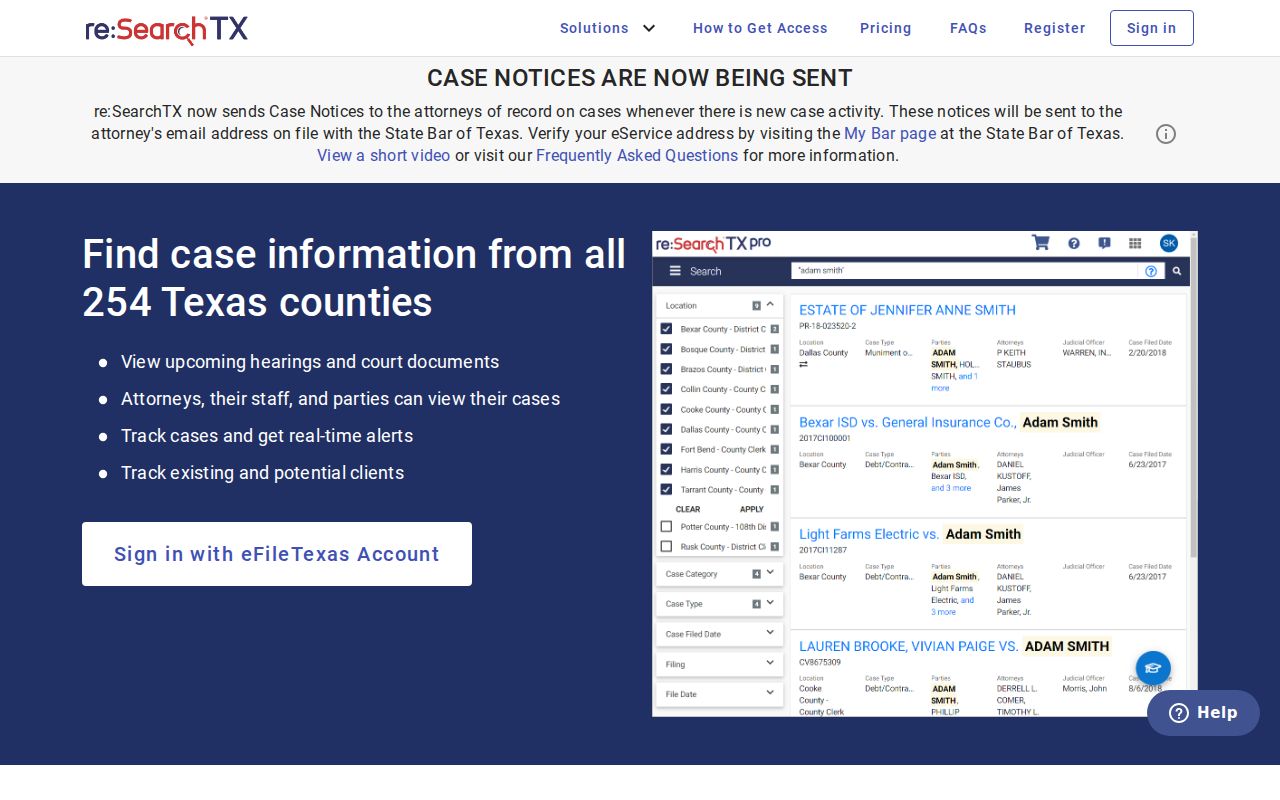
The image shows the separate court research modes. It does not show that any particular Odessa case, party, or image is open to every user.
| Court and division | Separates district, county court at law, municipal, and other jurisdictions. |
|---|---|
| Cause number and style | The stable case key and caption, stronger than a surname alone. |
| Party role | Identifies whether a name appears as a plaintiff, defendant, petitioner, respondent, attorney, or another role. |
| Event and filing dates | Separates filing, hearing, docket event, disposition, and recording dates. |
| Image status | Shows whether the result is a free index, a docket entry, a restricted image, or a copy-request lead. |
Odessa Voter Lookup Boundaries
Texas voter guidance outlines several search paths for the My Voter Portal. You can look up a record with a VUID. A driver's-license number works when one is on file. A first and last name works too. County, date of birth, and ZIP details can narrow the field further. A lawful public return may include a name, VUID, registration status, county, precinct, polling-place details, and election history. That is the limit the law permits. Take only the field you need for a civic or historical purpose.
A voter record is not a full address file. Social Security numbers, driver's-license numbers, and state-identification numbers stay confidential under Texas rules. Judges, peace officers, jailers, prosecutors, certain victims, and other protected groups can have their information suppressed. Address-confidentiality participants never appear on the normal voter list. A missing result may mean a no-match, an incomplete query, or a protected status. It is never a reason to rebuild a protected address from another source.
Ector County Elections handles local administration and public-records requests for a countywide or district file. The January 2022 request form asks for the requester's contact details. It also asks for the existing record sought, scope, date, format, signature, and pickup. It notes that requests depend on workload and open-records rules. It also displays a ten-working-day availability statement. Confirm all fees and formats with the office, since the posted form carries a date.
Chapter 552 Odessa Records
An online search sometimes comes back thin. When it does, the Texas Public Information Act, Government Code Chapter 552 gives you a procedure for requesting existing public records. The law does not force a custodian to answer a question or build a new report. It also does not require an open-ended continuing search. A request works best when it names the department and record type. Include the date range, location, account, case, permit number, and preferred format. For an Odessa record, ask for the inspection, notice, photograph, docket, or final-disposition file. Ask for what the office actually holds.
The county public-information office takes requests through its portal, email, mail, or in person. It sits at 300 N Grant, Room 227, Odessa, TX 79761, and lists pir@ectorcountytx.gov. Estimates above $40 are itemized. Deposits above $100 are possible, and an estimate carries a ten-day response window. Keep every estimate, deadline, production batch, and cited redaction with your match log. A delay or a redaction is a procedure to document, not evidence about a person.
Note: A focused request for one existing Odessa file beats a broad question about who lived somewhere.
Verify Odessa Resident Records
Verification tests whether two records describe the same person at the same time. It is not about gathering the most data. Start with a small identity anchor from the first record, such as a name paired with a historical address, a parcel account, or a cause number. Then check the second source for a matching date, role, address type, or record identifier. If a match stays ambiguous, label it ambiguous. A shared surname, a common street, or a partial name cannot turn a lead into a confirmed identity.
- Record the exact name, spelling variant, address type, and date from the first official source.
- Check a second source that can independently support the same time period, such as the land index or court index.
- Compare the cause number, instrument number, parcel account, issue date, or another record key instead of relying on a name alone.
- Classify the result as exact, probable, ambiguous, or not established, and record the access limit if a source is restricted.
- Request a custodian copy only when the needed record is available through that office and the access rules permit it.
- Docket
- A clerk's running record of case events. It is not automatically the final order or disposition.
- Index versus image
- An index is a searchable record listing; an image is the underlying document or scan, which can have different access rules.
- Certified copy
- A custodian-issued copy bearing the certification required for the purpose for which it is requested.
Odessa Vital Record Limits
Ector County serves as the local registrar for county birth, death, and marriage records. Its page lists Ector births and deaths from 1903 to the present. Marriage licenses run from 1891 to the present. Birth certificates stay restricted for 75 years after filing, and death certificates for 25 years. Qualified applicants include the registrant and specified immediate relatives. Legal representatives also qualify, as do people with a direct and tangible interest recognized by law. The County Clerk decides whether submitted photo identification is sufficient.
Access routes differ. The Clerk offers in-person service at 300 N Grant, Room 111. Mail requests go to PO Box 707. An online ordering route exists too. The local page tells mail applicants to include identification, contact information, and the payment it specifies. The county's 1903 local coverage statement differs from an online vendor's 1906 claim for some local and surrounding records. Treat the Clerk's page as the controlling local statement until that discrepancy is resolved. A vital index or verification is not the same as a certified record.
Marriage and divorce also need separating. A certified marriage license comes from the County Clerk. A divorce decree comes from the District Clerk. State verification routes carry their own coverage dates and are not legal substitutes for certified documents.
Odessa Resident Lookup Match Log
A short match log keeps an Odessa resident lookup on track. It stops the search from drifting into a pile of untested results. Log the exact query, the time searched, the number of returns, and the record identifier. Then write a confidence note. It should state whether the result is exact, probable, ambiguous, or not established. The log also preserves a useful negative result: a source may be unavailable, restricted, outside its coverage period, or searched under a different spelling or address form.
- Source name and official URL
- Exact search terms and filters used
- Date searched and result count
- Account, instrument, cause, or issue identifier
- Address type, date, and stated access limit
- Confidence note and the next lawful record to check
Copy as little as possible from a result. Skip the full date of birth, driver's-license number, Social Security number, personal phone number, or personal email when a less identifying citation answers the question. A current public result can still be incomplete, old, or matched to another person with the same name.
Odessa Family Connection Paths
A family-history question calls for different tools than a routine name search. Adult adoptees, birth parents, and biological siblings can register with the Texas Central Adoption Registry. It is a voluntary mutual-consent system. The right to refuse contact is built in. Adoption records and identities stay protected by confidentiality rules. This is not a general family-search database. Nobody should use it to pressure or track a person.
Older Odessa addresses need a different route. Try the library's genealogy staff, the UT directory catalog, or Ector microfilm. Each can help with a dated household question. Begin with the issue, page, reel, or series that actually exists in the collection. Those materials can support a documented household timeline. An old published listing is history, not a current resident record.
Legal Limits for Odessa Lookup
Texas public-record access has firm limits. Court and police files may carry redactions, sealed matters, juvenile protections, or confidential victim details. Voter rolls keep protected identifiers under suppression rules. A qualifying household can join the Texas DPS Address Confidentiality Program. It provides a substitute mailing address in specified government settings. For voter context, the Texas SOS address-confidentiality guidance covers the same ground. Never try to obtain motor-vehicle information. Do not work around a protected address through other public sources.
Lawful use. Use an Odessa resident lookup for lawful personal research, not to intimidate, monitor, stalk, or harass anyone. Texas Penal Code Section 42.07 addresses harassment, and Section 42.072 addresses stalking.
Access still requires care. Limit what you collect, keep a clear source log, verify each record with its custodian, and report threats to law enforcement. A correction or removal request goes to the agency that controls the underlying record.