
Odessa City Directory Collections
Odessa city directory research begins with the publication record, not an assumption that every year was printed or scanned. The UT Austin Briscoe Center catalog identifies ten Odessa-related directory records, including telephone, city, business, and regional oil-field titles. The Ector County Library supplies a local-history setting for follow-up, while the Texas State Library and Archives Commission preserves related Ector microfilm. Each source answers a different question. A catalog establishes that an issue is described; a library or archive may offer access; a page image or reel is the evidence that should be read and cited.
| Collection | Years | Where Held | Access |
|---|---|---|---|
| Odessa Telephone Directory, Southwestern Bell/SBC | Listed issues, 1930-2005, with gaps | UT Austin Briscoe Center catalog | Online catalog and citation metadata; no Odessa scan was inspected |
| Odessa City Directory, Lloyd's Directory Service | 1955, 1966, 1967 | UT Austin Briscoe Center catalog | Online catalog and citation metadata |
| Johnson and Cole Odessa directories | 1981, 1982, 1986 | UT Austin Briscoe Center catalog | Cataloged issue records |
| Ector vital-record microfilm companion sources | Deaths 1903-1971; marriage index 1891-1994 | Texas State Library and Archives Commission; UTPB is listed locally | Microfilm finding aid and in-person access lead |
| Southwest History and Genealogy local collection | Specific Odessa directory run not published online | Ector County Library | Ask genealogy staff about holdings and copies |
That distinction matters in Odessa. The library's official page does not publish a verified run of reverse directories, telephone books, obituary indexes, or funeral-home files. It is more accurate to ask staff about a title and issue than to treat a web-page omission as proof that a volume does not exist. Likewise, the Briscoe catalog describes directory records and citation details, not a freely viewable Odessa page for every listed issue.
Odessa Directory Years at UT
The cataloged Southwestern Bell and SBC telephone sequence is the broadest Odessa run identified in the research. It begins with April 1930 and includes scattered early issues, annual or near-annual groups in later decades, and listed issues through October 2005. The record also notes Odessa and surrounding places and the 432/915 area-code context. That makes the run helpful for a surname, an address, or a local telephone listing, but a surrounding-place entry must not be presented as a complete Odessa household record.
The Odessa catalog results also separate Lloyd's city directories from later Johnson and Cole volumes. Lloyd's appears for 1955, 1966, and 1967. Johnson Publishing appears for April 1981 and April 1982, and Cole Publications appears for January 1986. Record the publisher and issue date before comparing names. Publisher changes can change the fields, the territory, and the way a business or household was selected for publication.
The catalog view below is the source lead for the recorded title, publisher, and issue-date trail.
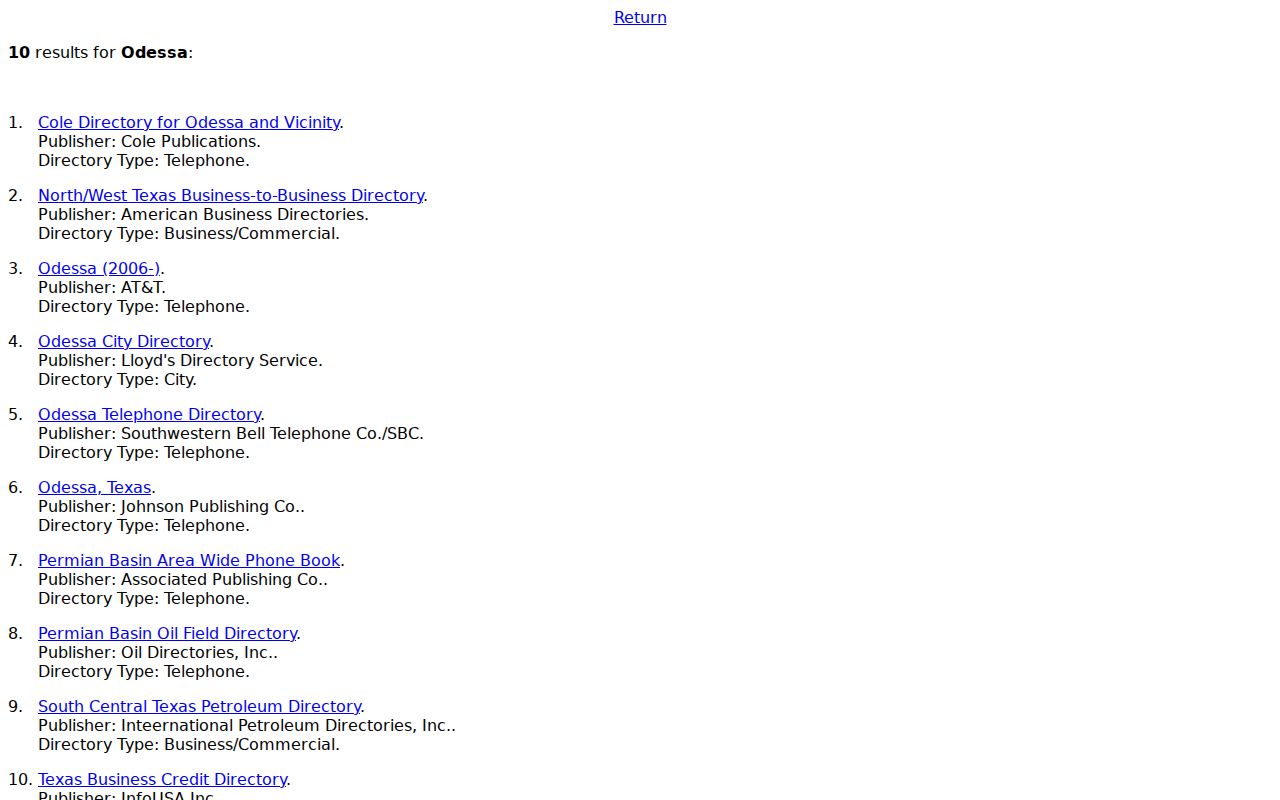
The catalog supports discovery and citation work. A volume still needs to be located, read, and paired with its own title-page date before it is used as a historical address finding.
Note: A regional directory can include Odessa without being a complete Odessa city directory.
Odessa City Directory Help Desk
The Ector County Library Southwest History and Genealogy department is a practical Odessa starting point when an issue, a surname, or an address needs context. Its collection covers Texas, Arizona, New Mexico, and Oklahoma and includes genealogy books, periodicals, federal census material, worldwide resources, and an Odessa, Ector County, and Texas clipping file. Ancestry.com is available on genealogy computers. First-time patrons can receive a pedigree chart and basic instructions, which makes the department useful for a family-history search that needs a clear record log rather than a loose pile of names.
The library is at 321 W 5th Street, phone 432-332-0633. General hours are Monday through Saturday, 9:00 a.m. to 7:00 p.m., with a Saturday lunch closure for the second and third floors. Genealogy staff are reached at extension 2112, and email questions should include a name, phone number, and “SW” in the subject. Before a trip, ask whether the exact issue is held, whether it is on paper or microfilm, the page or reel location, and whether a copy can be made.
The library genealogy department page shows the local-history setting and staff route for these Odessa city directory questions.
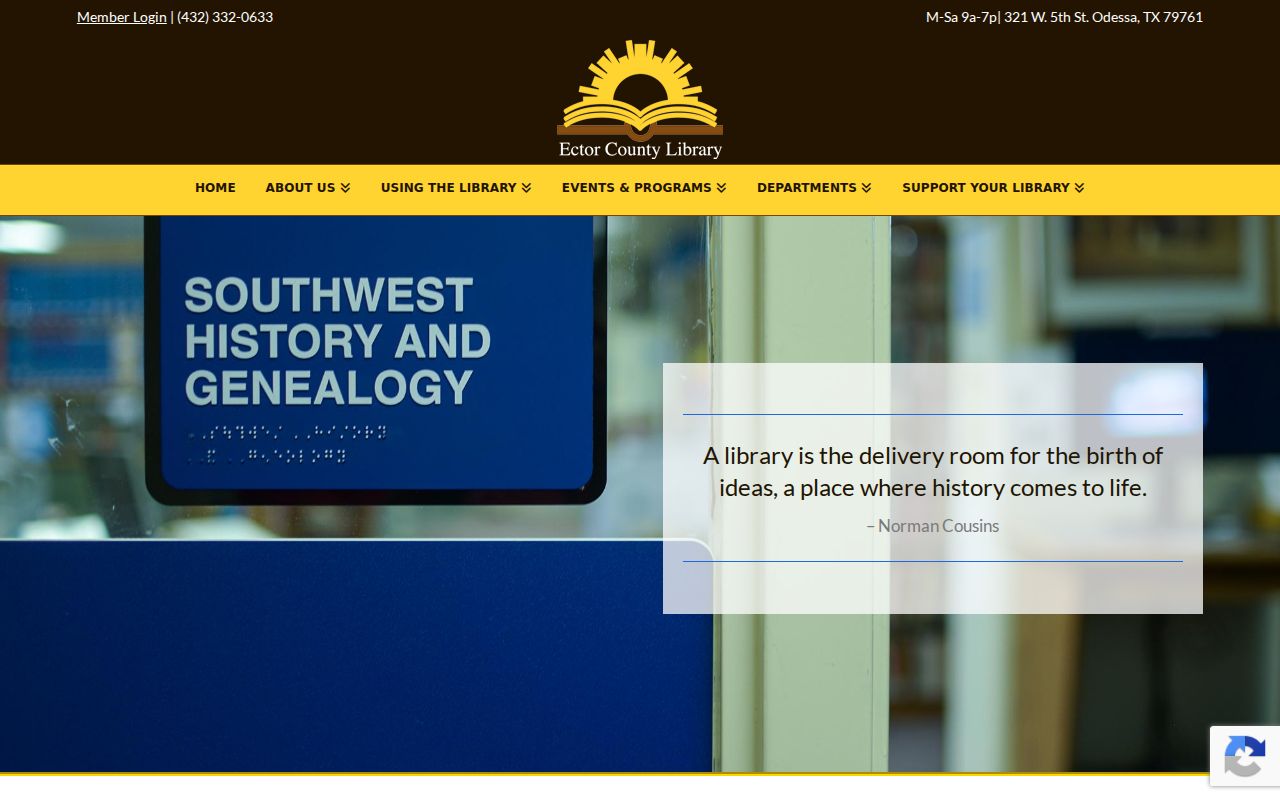
Library staff can explain the clipping file and resources not described online. They cannot turn an unverified catalog reference into proof of a household's residence.
Odessa Directory Microfilm Trail
The Texas State Library and Archives Commission Ector County holdings provide a parallel time trail when a directory entry raises a family-history question. The finding aid lists death records from 1903 through 1970 and a death index through 1971, plus marriage records from 1891 through 1951 and a male/female marriage index through 1994. It lists reel numbers and recorded-volume ranges, and identifies UTPB in Odessa as a local microfilm location. These are record companions, not city directory pages, but they can help test a dated listing against an event record.
The reels also contain a useful warning. The holdings list has missing or unlisted volume 4 and volume 7 gaps. A gap must stay a gap. Do not supply an event, a date, or a presumed residence because the surrounding volumes exist. The 1973 Ector County records inventory at UNT is another finding aid: it maps older County Clerk, District Clerk, Treasurer, Tax Assessor-Collector, Surveyor, and Sheriff series, but it is not a complete online name index.
The microfilm holdings page is the source for the reel ranges and local repository lead.
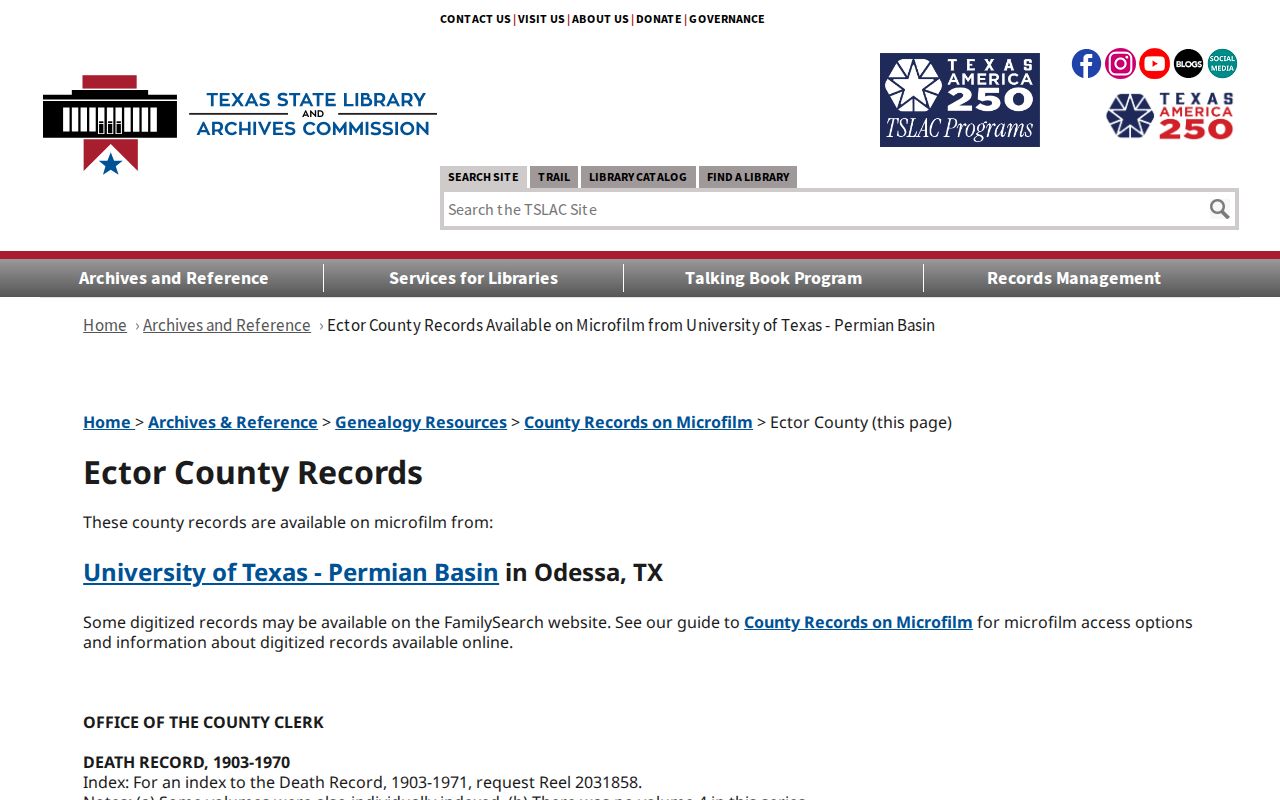
Use the listed series, volume, and reel to make a focused request. A request for a defined record has a clearer path than a broad request for everything about one name.
Reading Odessa City Directory Entries
An Odessa city directory entry should be captured as a dated publication line, not copied as if it were a current profile. The Texas State Library and Archives Commission explains that directories may include a name, address, telephone, spouse, occupation, and an owned or rented notation. An actual page can also have a page number, a publisher, an issue date, a cross-reference, or a warning about omissions. Keep those details together. They identify both what the entry says and what kind of list produced it.
| Publication identity | Title, publisher, issue date, and page establish which Odessa directory is being read. |
|---|---|
| Name line | Capture the alphabetical name exactly, including initials, spouse or household notation, and cross-references. |
| Address and telephone | Record the printed street number, street name, and telephone only as historical publication data. |
| Work or business notation | Preserve an occupation or enterprise statement when printed, without treating it as a current status. |
| Owner, renter, widow, or omission note | Copy the printed mark and the volume's key when available instead of guessing its meaning. |
- Criss-cross directory
- An address-ordered section that can be read from street and number to listed names. The research did not verify a locally held Odessa run.
- Householder index
- An alphabetical index organized around a named household or listing, when a publisher includes one.
- Abbreviation key
- The legend printed by a directory publisher. Photograph or copy it first because symbols can vary between issues.
For a possible address match, keep the issue date, page, and every printed field. Then test it with an independent source that serves the same time period. When the need is a present-day address record rather than a historical listing, use the Odessa street directory lookup for the modern address-keyed route.
Odessa City Directory Regional Context
Odessa directory research has a Permian Basin edge. The UT catalog also lists a Permian Basin Area Wide Phone Book, a Permian Basin Oil Field Directory, a North/West Texas business-to-business title, and petroleum directories. The regional titles can place an oil-field service, exchange, or business in a publication market that reached Odessa. They are useful for context when a conventional city directory issue is not located.
Regional coverage is not the same thing as an Odessa household roll. The Texas State Historical Association account of Odessa connects the railroad, early post office, town plat, and the 1926 oil discovery with later growth. That history helps explain why regional publications may matter, but the date on a particular directory or record remains the controlling fact. The 1927 and 1950 Sanborn map dates can add block and building context without naming a current resident.
Note: A business listing is a publication finding, not proof of a household at the same address.
Odessa Directory Records Timeline
Dates help sort an Odessa city directory into the larger Ector County record trail. Ector County was formed from Tom Green County in 1887 and organized in 1891. The county later moved through four courthouse eras as Odessa expanded from a railroad settlement into an oil-region center. Older volume references may therefore use an office, courthouse, or address convention that differs from a modern search screen. A modern account number is convenient, but it does not replace the older trail.
- 1887: Ector County was created from Tom Green County.
- 1891: Ector County was organized, and marriage records in the microfilm finding aid begin.
- 1903: The Ector death-record trail begins in the state holdings list.
- 1930: The UT catalog lists an April Odessa telephone directory issue.
- 1955 to 1967: Lloyd's Odessa City Directory issues are cataloged for three years.
The sequence is a research aid, not a claim of continuous publication. Catalog gaps, unscanned pages, and changed publishers should be noted in a household timeline rather than silently filled.
Trace Odessa City Directory Families
Family history work is strongest when it moves from one dated Odessa city directory entry to another, then checks the dates against records that have known custodians. Start with the earliest confirmed issue, preserve the printed address and page, and follow forward only where the same name, household notation, or address makes sense. A disappearance can mean a move, an unlisted telephone, an editorial choice, or an event between issues. It does not prove a death or a new household by itself.
- Find the first cataloged issue that may contain the name or street and record its publisher and date.
- Capture the entry, page, address, and any household or business notation exactly as printed.
- Compare the next available issue, noting an address change, spelling change, or absence without guessing why it occurred.
- Pair each dated directory finding with the appropriate census period, microfilm series, deed, or public record.
- Ask the library or archive for the exact issue, reel, or collection when the catalog does not supply a page image.
A historical directory can support a past-address question. A name found there can be checked in the Odessa resident lookup records sequence only when a modern record is needed and the access rules allow it. Keep historical and current claims separate.
Odessa City Directory Limits
Odessa city directories are useful historical snapshots, not complete rolls of every person who lived in the city. The research did not locate an official Odessa digitized-directory page image, an online verified criss-cross run, or a named local obituary index. The library, UT catalog, TSLAC holdings, and UNT inventory are still worthwhile because each states what it has or what it can help locate. Their limits are part of the record trail.
Use a directory for the narrow statement it supports: that a particular publication printed a particular entry at a particular time. Do not turn a telephone number into a current contact field, a business line into a household claim, or an unverified absence into a life event. For an old address, Sanborn maps can add building context, but they are not current parcel records. Respect protected information and keep research focused on family history, estate questions, and other lawful personal purposes.
Note: Verify any needed copy, fee, and access rule with the holding institution before relying on it.